
Tech Pack Room · guide 01
 Points of
 Measure
Where the tape goes, and how far it can be off.
A size chart is only as good as its measuring points. Here is where every point sits on a tee, a hoodie and a pair of trousers, how to take it, and how much it can move before a piece fails quality control.
Before the tape comes out
 Ground Rules
Six rules every factory measures by.Follow them and your numbers mean the same thing on their table as on yours.
- 01
Lay it flat
Measure the finished garment on a table, zips and buttons closed. Smooth it with your hand; never pull it.
- 02
Widths are halves
Chest, waist, hip and openings go straight across the flat garment: one side, not all the way round. Write “1/2” in the name.
- 03
Lengths start at the HPS
The high point shoulder is where the shoulder seam meets the neckline. Body lengths drop from there, straight down, parallel to the centre front.
- 04
Centimetres, to 0.5
A soft tape in centimetres, read to the nearest half centimetre. Name the unit on every sheet.
- 05
Say where it starts
Seam to seam is not edge to edge. Every point below says exactly where the tape starts and stops.
- 06
Stretch only when asked
Rib and elastic get two numbers: relaxed, and extended (stretched to the full). The chart says which.
Regular fit, crew neck, set-in sleeves
 The Tee
Thirteen points, A to M.Point at a row, or tap a letter on the sketch, to see where the tape goes.
| Point | How to measure | Typical tolerance |
|---|---|---|
| ABody length | From the HPS straight down to the bottom edge, parallel to the centre front. | ±1.5 cm |
| BChest width (1/2) | Straight across, 2.5 cm below the underarm, side seam to side seam. | ±1.5 cm |
| CBottom width (1/2) | Straight across the bottom edge, side seam to side seam. | ±1.5 cm |
| DShoulder width | Across the back, from one shoulder point to the other, where the sleeve seam meets the shoulder seam. | ±1 cm |
| EArmhole, straight | From the shoulder point in a straight line to the underarm point. | ±1 cm |
| FSleeve length | From the shoulder point along the top fold to the sleeve edge. | ±1 cm |
| GBicep (1/2) | 2.5 cm below the underarm, straight across the sleeve, parallel to the sleeve opening. | ±0.5 cm |
| HSleeve opening (1/2) | Straight across the sleeve edge, laid flat. | ±0.5 cm |
| INeck width | From one HPS to the other, seam to seam. | ±0.5 cm |
| JFront neck drop | From the line between the two HPS straight down to the neck seam at the centre front. | ±0.5 cm |
| KBack neck drop | From the line between the two HPS straight down to the neck seam at the centre back. | ±0.3 cm |
| LNeck rib height | From the neck edge to the rib seam, at the centre front. | ±0.3 cm |
| MHem height | From the bottom edge to the stitching line. | ±0.3 cm |
Pullover, dropped shoulder, kangaroo pocket
 The Hoodie
Fifteen points, A to O.The body works like the tee. The hood, the rib and the pocket add their own.
| Point | How to measure | Typical tolerance |
|---|---|---|
| ABody length | From the HPS, where the shoulder seam meets the hood seam, straight down to the bottom edge of the rib. | ±1.5 cm |
| BChest width (1/2) | Straight across, 2.5 cm below the underarm, side to side. | ±1.5 cm |
| CBottom rib width, relaxed (1/2) | Straight across the bottom edge of the rib, without stretching it. | ±1 cm |
| DShoulder width | Across the back, shoulder point to shoulder point. On a dropped shoulder the point sits out on the arm. | ±1 cm |
| EArmhole, straight | From the shoulder point in a straight line to the underarm. | ±1 cm |
| FSleeve length | From the shoulder point along the top fold to the cuff edge, cuff included. | ±1.5 cm |
| GBicep (1/2) | 2.5 cm below the underarm, straight across the sleeve to the top fold. | ±1 cm |
| HCuff width, relaxed (1/2) | Straight across the cuff edge, without stretching it. | ±0.5 cm |
| ICuff height | From the cuff seam to the cuff edge. | ±0.3 cm |
| JBottom rib height | From the rib seam to the bottom edge. | ±0.3 cm |
| KHood height | Hood laid flat: from the HPS straight up to the top of the hood. | ±1 cm |
| LHood width | Hood laid flat: straight across one side at its widest, from the centre seam to the outer edge. | ±1 cm |
| MPocket width | Straight across the bottom of the pocket, edge to edge. | ±0.5 cm |
| NPocket height | At the centre, from the top edge of the pocket to the bottom. | ±0.5 cm |
| OPocket placement | From the line between the two HPS straight down to the top edge of the pocket. | ±0.5 cm |
Shown on joggers: the points are the same for any trousers
 The Trousers
Twelve points, A to L.Rises run along the seams; everything else goes straight across or straight down.
| Point | How to measure | Typical tolerance |
|---|---|---|
| AWaist, relaxed (1/2) | Straight across the top of the waistband, without stretching it. | ±1 cm |
| BWaist, extended (1/2) | Straight across the top of the waistband, the elastic stretched to its full. | ±1.5 cm |
| CWaistband height | From the top edge of the waistband to its bottom seam. | ±0.3 cm |
| DHip (1/2) | Straight across, side to side, 18 cm below the top of the waistband. | ±1.5 cm |
| EFront rise | From the crotch seam junction up the centre front seam to the top of the waistband. | ±0.5 cm |
| FBack rise | From the crotch seam junction up the centre back seam to the top of the waistband. | ±1 cm |
| GThigh (1/2) | 2.5 cm below the crotch, straight across one leg, at a right angle to the leg. | ±1 cm |
| HKnee (1/2) | Halfway down the inseam, straight across the leg. | ±0.5 cm |
| ILeg opening (1/2) | Straight across the bottom edge, relaxed: cuffs are not stretched. | ±0.5 cm |
| JInseam | From the crotch seam junction down the inside leg seam to the bottom edge. | ±1 cm |
| KOutseam | From the top of the waistband down the side seam to the bottom edge. | ±1 cm |
| LCuff height | From the cuff seam to the bottom edge. | ±0.3 cm |
How far is too far
 Tolerances
The give a garment gets before it fails.Agree the numbers before the sample, write them in the tech pack, and check every size in quality control against the same chart.
| Kind of point | Examples | Typical tolerance |
|---|---|---|
| Lengths | Body, sleeve, inseam, outseam | ±1 to 1.5 cm |
| Widths (1/2) | Chest, waist, hip, bottom | ±1 to 1.5 cm |
| Fit points | Shoulder, armhole, thigh, rise | ±0.5 to 1 cm |
| Openings | Neck, sleeve, cuff, leg | ±0.5 cm |
| Small points | Neck drops, rib and hem heights, placements | ±0.3 to 0.5 cm |
Knits move more than wovens
Jersey, fleece and rib relax and grow, so they take the upper end. Denim and shirting take the lower end.
Tight costs money
Every half centimetre of extra precision means more checks and more rejects. Be strict where the fit lives, easy where it doesn’t.
Washed? Measure after
Garment-dyed and washed pieces shrink. Measure them finished, after the wash, and say so on the chart.
Free download
Print it. Tape it. Fill it in.
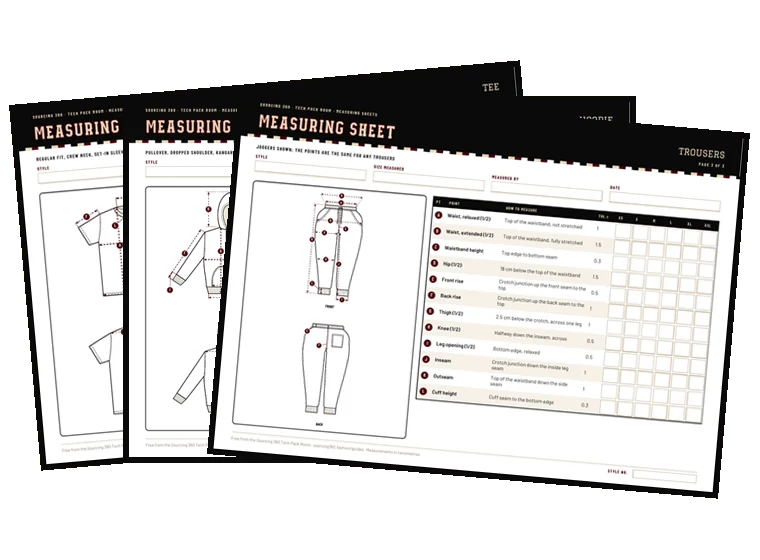
The measuring sheets: one page each for the tee, the hoodie and the trousers, with the lettered sketches, how to take every point, and a blank size chart from XS to XXL with a tolerance column. Fill them in on screen or with a pen.
Straight answers
 Time Out
Why are widths half measurements?
Because a garment laid flat shows one side. 53 cm across the chest, flat, is a 106 cm chest all the way round. Half is what everyone measures on the table, so it is what the chart uses. Write “1/2” in the point’s name so nobody doubles it twice.
Where exactly is the HPS?
The high point shoulder is where the shoulder seam meets the neckline, or the hood seam on a hoodie. On a raglan sleeve it is where the sleeve seam meets the neck.
Do I close the zips and buttons?
Yes. Close everything, lay it flat, smooth it with your hand and don’t pull. Tuck the cords in. Sleeves lie at their natural angle.
I have a garment that fits perfectly. Can you copy the fit?
Measure it with this guide and send us the numbers, or send us the garment itself: our pattern team measures it and builds your size chart from it.
I don’t know my measurements at all.
Send what you have: a reference garment, a brand whose fit you like, or just your size range. S360 Studio and our pattern team propose a chart for you to approve.
Inches or centimetres?
We work in centimetres. If your chart is in inches, write the unit on every page. One inch is 2.54 cm.
Keep studying
More from the Tech Pack Room
- 01Guide
Points of measure
Where the tape goes on a tee, a hoodie and joggers.
- 02Guide + grader
Size grading
One sample size into a full run, with a free grader.
- 03Guide + template
Bill of materials
Every fabric, trim, label and bag, on one sheet.
- 04Template
Tech pack
Nine pages, fillable on screen, with a worked example.
Ready when you are
 Your Move.
Your first run starts at 50 pieces, with a sample in 8–21 working days. Send us the pack, or just the idea.

- We reply within 24 hours
- We work under NDA
- We ship worldwide